Kurukshetra War
Bhagavad GitaThe Kurukshetra War is the great conflict on the sacred plain of Kurukshetra in which the Pandavas and Kauravas meet as opposing armies, while Arjuna’s refusal to fight transforms the opening of battle into the setting for the Krishna–Arjuna Dialogue. The war’s decisive significance lies in this interruption: before weapons can determine the fate of the kingdoms, Arjuna’s crisis makes the meaning of violence, duty, death, responsibility, and liberation the central questions of the narrative.
Sacred Ground and Opposing Armies
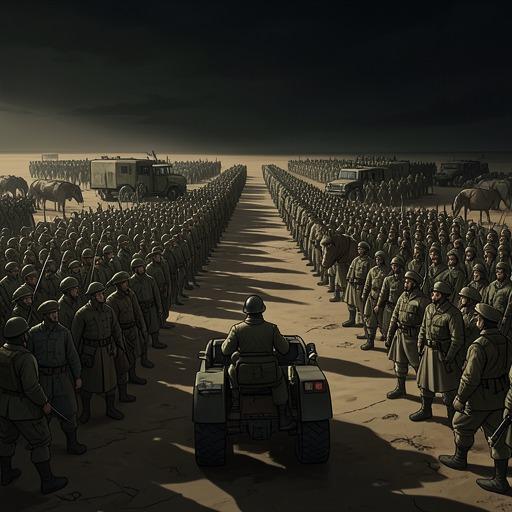
Dhritarashtra begins the account by asking Sanjaya what his sons and the Pandavas did after assembling on the sacred plain of Kurukshetra with the desire to fight. The question establishes the war as both a dynastic confrontation and an event occurring in a consecrated space. The battlefield is not treated as an ordinary field. It is the place where inherited claims, family loyalties, royal ambition, social order, and religious obligation are brought into direct collision.
Sanjaya first describes Duryodhana observing the Pandava army and approaching Drona. He points to the army’s numerous mighty bowmen, including warriors equal in battle to Bhima and Arjuna, and names Yuyudhana, Virata, Drupada, Dhrishtaketu, Chekitana, the ruler of Kasi, Purujit, Kuntibhoja, Saivya, Yudhamanyu, Uttamaujas, Subhadra’s son, and the sons of Draupadi. He then identifies the distinguished leaders on his own side: Drona, Bhishma, Karna, Kripa, Ashwatthaman, Vikarna, Saumadatta, and Jayadratha. Duryodhana claims that the Kaurava army, protected by Bhishma, is insufficient, whereas the Pandava force, protected by Bhima, is sufficient, and he orders the warriors to guard Bhishma above all.
The armies are defined through sound before they are defined through combat. Bhishma gives a leonine roar and blows his conch, after which conches, drums, cymbals, and horns erupt together. Krishna and Arjuna, stationed on a great chariot yoked to white steeds, answer with their celestial conches: Krishna blows Panchajanya and Arjuna blows Devadatta. Bhima sounds Paundra; Yudhishthira sounds Anantavijaya; Nakula and Sahadeva sound Sughosa and Manipushpaka. Other Pandava allies, including the ruler of Kasi, Shikhandin, Dhrishtadyumna, Virata, Satyaki, Drupada, the sons of Draupadi, and the son of Subhadra, sound their conches as well. The reverberation fills the sky and earth and strikes fear into the hearts of the Kauravas, turning military preparation into a ritualized declaration of opposing powers.
Arjuna’s Refusal to Fight
When the throwing of missiles is about to begin, Arjuna raises his bow and asks Krishna to place the chariot between the two armies. He wants to see those assembled for battle and to identify the men with whom he must contend in the struggle undertaken for the benefit of Duryodhana. Krishna places the chariot before Bhishma, Drona, and the assembled kings, directing Arjuna’s sight toward the full human meaning of the impending battle.
From the chariot, Arjuna sees sires, grandsons, friends, fathers-in-law, well-wishers, preceptors, sons, grandsires, maternal uncles, grandsons, brothers-in-law, and other kinsmen standing in both armies. The military formation becomes a family gathering transformed into a killing ground. His body responds before his reasoning is complete: his limbs grow languid, his mouth dries, his body trembles, his hair stands on end, his skin burns, his mind wanders, and Gandiva slips from his hand. He sees adverse omens and declares that he does not desire victory, sovereignty, pleasures, or even life when those for whose sake such rewards are desired stand ready to die.
Arjuna’s objection is not limited to personal grief. He argues that killing the Kauravas would bring sin even if they are regarded as enemies, because they are still his own kinsmen. He fears the extermination of the race, the destruction of eternal family customs, the spread of sin, the corruption of women, the intermingling of castes, the fall of ancestors when rites of pinda and water cease, and the extinction of family rules and ceremonies. He sees the war as a chain of consequences extending beyond the battlefield into household continuity, ancestral obligations, social identity, and the destiny of the dead.
He finally judges the desire for sovereignty to be a motive for perpetrating a great sin. Better, he says, would be to let the armed sons of Dhritarashtra kill him while he remains unarmed and does not retaliate. Having spoken, Arjuna casts aside his bow and arrows and sits down on his chariot, overwhelmed by grief. The war has not ended, but its first decisive movement is Arjuna’s withdrawal from action.
Divine Argument and the Revaluation of Battle
Krishna first rebukes Arjuna’s despondency as unworthy at such a crisis and urges him to shake off weakness and rise. Arjuna answers that he cannot understand how to fight Bhishma and Drona, both deserving worship. He would rather live on alms than kill his preceptors and enjoy pleasures stained by their blood. Unsure whether victory or defeat would be preferable, he asks Krishna to tell him what is truly good, declares himself Krishna’s disciple, and confesses that he sees no remedy for his grief even in a prosperous kingdom on earth or sovereignty over the gods. He then says that he will not fight and remains silent.
Krishna’s response changes the war’s governing scale. He teaches that the soul is distinct from the body, immortal, indestructible, unborn, unchangeable, and never slain when the body perishes. The soul is compared to a person casting off worn-out robes and putting on new ones. Weapons cannot cleave it, fire cannot consume it, water cannot drench it, and wind cannot dry it. Since embodied beings are unmanifest before birth, manifest between birth and death, and unmanifest again after death, Krishna asks what ground there is for grief over an unavoidable transition.
This teaching does not simply dismiss Arjuna’s compassion; it relocates the question of killing within a larger account of embodiment and duty. Krishna tells him that, as a Kshatriya, he has no duty better than a fair battle. Such a battle arrives like an open gate of heaven. If Arjuna refuses, he will abandon his prescribed duty and fame, incur sin, and become the object of lasting infamy. Great warriors will believe that he withdrew from fear, enemies will decry his prowess, and those who once respected him will think lightly of him. If slain, he will attain Heaven; if victorious, he will enjoy the Earth. He must therefore rise and fight, treating pleasure and pain, gain and loss, victory and defeat as equal.
The argument then develops into a doctrine of disciplined action. Work is unavoidable: no one can remain even for a moment without acting, and mere renunciation does not produce freedom from work. Action performed for sacrifice does not bind, whereas action pursued for private attachment does. The ancient cycle joins work, sacrifice, the Vedas, food, and the sustenance of creatures; one who consumes what is given without returning an offering is described as a thief. Arjuna’s battle is consequently placed within a wider order in which action must be performed without attachment to its fruits.
Krishna states the principle with particular force: Arjuna’s concern is with work, not with its fruit. He must not make the result his motive, nor become attached to inaction. The war thus becomes the testing ground for action without possessiveness. Its moral problem is not solved by simple violence or simple abstention; it is reframed as whether action can be undertaken as duty, sacrifice, and service rather than as a grasping pursuit of sovereignty.
Cosmic Scale and Irreversible Consequences
Krishna identifies the teaching as an imperishable system of devotion transmitted from Vivasvat to Manu and from Manu to Ikshaku, later known by royal sages, and eventually lost to the world through the passage of time. He now declares it to Arjuna because Arjuna is both devotee and friend. The war is therefore linked to a broken and renewed transmission of sacred knowledge: the battlefield becomes the place where an ancient doctrine is restored.
Krishna further explains that, although unborn and imperishable, he takes birth through his own powers of illusion whenever piety declines and impiety rises. He is born age after age to protect the righteous, destroy evildoers, and establish piety. The war is consequently represented within a recurring cosmic pattern rather than as an isolated dynastic accident. Its violence belongs to a larger restoration of order, even though the immediate human cost remains concentrated in the faces Arjuna recognizes as family.
The same enlargement appears in the teaching on death and cosmic time. At the time of departure, remembrance determines the destination toward which a being goes; one who remembers Krishna at the final moment comes to Krishna’s essence. Krishna instructs Arjuna to think of him at all times while engaging in battle. The devotee who fixes mind and understanding on Krishna, meditates without distraction, and departs while uttering Om reaches the highest goal. All worlds, from Brahmaloka downward, pass through rebirth, but reaching Krishna ends return to the sorrowful and transient cycle.
The universe itself moves through immense alternations. A Day of Brahma lasts a thousand Yugas, and a Night of Brahma lasts another thousand. During the day, manifest beings spring from the unmanifest; during the night, they disappear into it, only to emerge again under the force of action. Beyond this recurring unmanifest state lies another eternal and indestructible reality, the supreme seat from which there is no return. The war is thus suspended between two kinds of time: the immediate time of armies and decisions, and the cosmic time of creation, dissolution, rebirth, and release.
The text also distinguishes two paths after death. Through fire, light, day, the bright fortnight, and the six months of the northern solstice, those who know Brahman go to Brahman and do not return. Through smoke, night, the dark fortnight, and the six months of the southern solstice, a devotee reaches lunar light and returns. Knowing these paths, the devotee is not deluded. The battlefield’s stakes therefore exceed victory or defeat: action occurs within a universe where the manner of consciousness at death determines whether one returns or crosses beyond return.
The War as Divine Instrument and Ethical Threshold
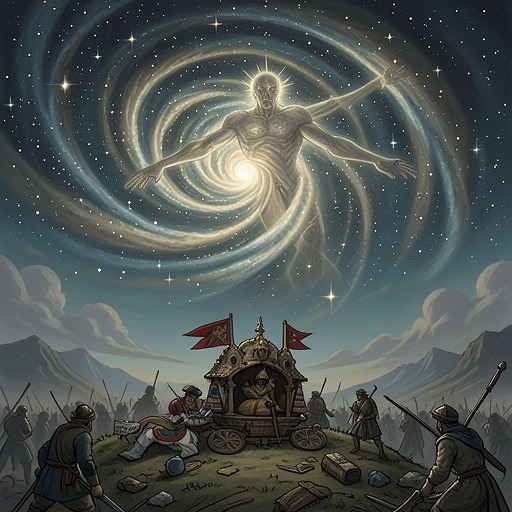
The most terrifying reinterpretation comes when Krishna reveals the Vishvarupa. Arjuna sees warriors from both sides entering Krishna’s blazing mouths, their heads crushed among his teeth, rushing like currents toward the ocean and like moths toward fire. The vision turns the armies into figures already moving toward destruction. The human battle remains visible, but it is now contained within a cosmic act of devouring.
Krishna identifies himself as Death, the destroyer of worlds, fully developed and engaged in slaying the race of men. He declares that, without Arjuna, the warriors in the divisions will cease to be. Drona, Bhishma, Jayadratha, Karna, and other heroic warriors have already been slain by him; Arjuna is told to become merely his instrument. Krishna commands him to arise, gain glory, vanquish the foe, and enjoy the kingdom. The order does not erase Arjuna’s agency, but it changes its meaning: Arjuna is not represented as the independent author of the warriors’ destruction, yet he remains responsible for accepting or refusing the role assigned to him.
The final teaching returns the vast vision to the practical crisis. Krishna distinguishes action and inaction, duty and non-duty, bondage and deliverance according to the quality of intellect, and he classifies constancy and happiness through the three qualities of nature. Bravery, energy, firmness, skill, refusal to flee from battle, liberality, and the bearing of a ruler are named as the natural duties of a Kshatriya. Every person, Krishna says, can attain perfection through the performance of his or her own duty; one’s own duty, even imperfectly performed, is better than another’s duty well performed.
Krishna specifically tells Arjuna that he must not abandon his natural duty merely because every action is touched by imperfection, as fire is enveloped by smoke. If Arjuna refuses to fight through self-conceit, nature will constrain him, and the duty arising from his own nature will cause him to do involuntarily what he now refuses. Krishna nevertheless leaves Arjuna a final space of deliberation: after declaring the mysterious knowledge, he tells him to reflect fully and act as he chooses. The command is therefore framed by both divine authority and a demand for conscious understanding.
Significance and Narrative Outcome
The Kurukshetra War functions as a battlefield, a family catastrophe, a ritual threshold, and a philosophical laboratory. Its opening soundscape gathers named warriors and weapons into a public display of force; its central pause exposes the intimate cost of that force; and its theological discourse converts a dynastic crisis into an inquiry into the soul, duty, sacrifice, devotion, and liberation. The war’s apparent interruption is thus its most consequential action, because Arjuna’s hesitation makes visible the conflict between competing moral orders.
The conflict also repeatedly contrasts finite human calculation with a larger order. Arjuna thinks in terms of kinsmen, sovereignty, bloodstained pleasure, social ruin, and ancestral loss. Krishna answers through immortality, Kshatriya duty, action without attachment, divine incarnation, cosmic recurrence, and the supreme goal beyond rebirth. The result is not a denial that war destroys families; the text preserves that horror in Arjuna’s physical collapse and in his catalogue of threatened customs. Rather, it places the destruction inside a theology in which refusal, action, consequence, and liberation are all judged according to the consciousness and duty through which they are undertaken.
The war’s immediate conclusion in the supplied account is not a narrated military victory but a transformed decision point. Arjuna begins by lowering Gandiva, refusing to fight, and sitting down in grief. Krishna leaves him with the command to take refuge, dedicate action to him, overcome difficulty through grace, and rise for battle. The narrative therefore treats the Kurukshetra War as the event that makes action possible only after its moral meaning has been contested, enlarged, and placed within the cosmic order.